Three books I can’t stop thinking about
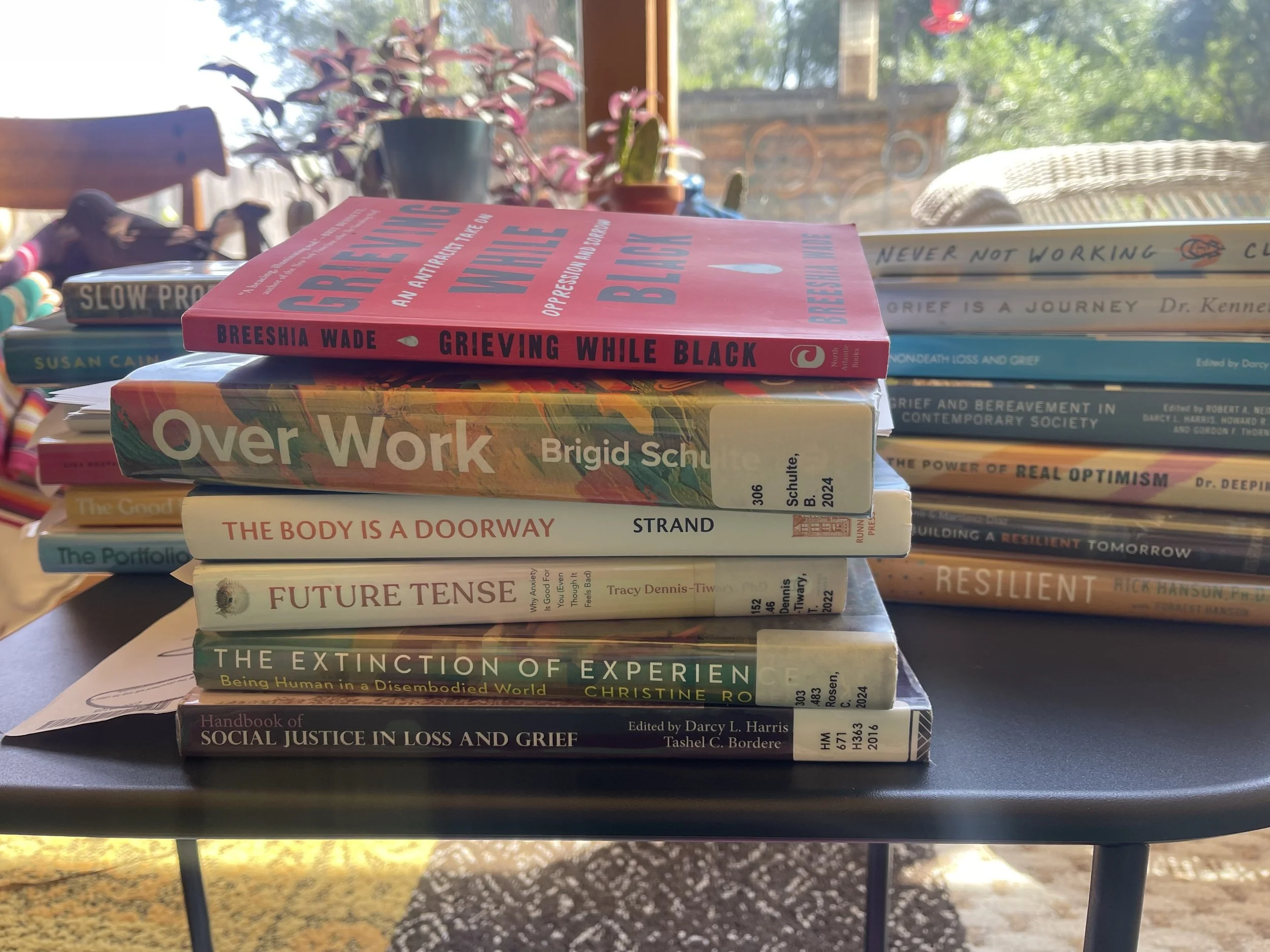
Being full-on in the brainstormy stage of a creative endeavor means I’m joyfully surrounded by piles and piles of library books. The middle pile is my active reading pile, aka the books I’m rotating through depending on the moment and my mood.
Work Won't Love You Back: Devotion to Our Jobs Keeps Us Exploited, Exhausted, and Alone by Sarah Jaffe (2021)
Modern work, as most of us experience it, is built on a false narrative of “love what you do and never work a day in your life” and that we can (and should) find happiness through our work/careers. She builds the case that this has all been a con job to keep us overworking for the profit and fame of a select few. On top of that, the language of labor of love gaslights us into thinking any problems or fractures are within us so that we don’t look too closely at the systems that have alienated us from actual life fulfillment and happiness. Jaffe provides such good historical context and commentary on labor labeled as 'care' or 'labor of love' work: “neoliberalism tried to sell us on freedom not from work but through work.” (p 10). Bonuses: for education and academic readers, there are dedicated chapters on education and faculty as proletarian professionals. There are chapters for nonprofit folks and creative artists, as well, where she traces the gendered norms of ideal and power structures.
Over Work: Transforming the Daily Grind in the Quest for a Better Life by Brigid Schulte (2024)
Similar in ways to Jaffe's arguments, Schulte takes the angle that work has become our new religion and that most modern professions now experience the "crappification" of paid work under "cowboy capitalism." In our US overwork culture, the ideal worker is single-mindedly dedicated to work, without caregiving “distractions.” This is why paid work is gendered as a masculine domain based on the 1950-60s white middle-class norms and hasn’t changed the expectations, despite the lack of ideal workers in reality. She argues that the Great Resignation was actually a desire for the Great Reimagining, and that businesses fell short after the pandemic. She says what motivates workers is actually also good for organizations: fair treatment, a promising future path, psychological safety, a sense of mission and purpose. These are definitely behaviors missing in the 2026 workplace due to choices from people who make decisions, and, according to Schulte, we can force better decisions.
Lighting Flowers by Katherine Standefer (2020)
I’ve gotten to know Kati in the writer’s community on Substack where she pens The Wild and Holy Moment. I devoured her captivating, investigative-like memoir that weaves her own story of having a defibrillator implanted in her early 20s due to a surprising genetic long QT diagnosis. She proceeds to trace the origins of the machine parts and the many lives that go into making these life-saving devices - as she says, “the cost of saving a life.” The familiarity of the landscapes of Colorado, Tucson, and Wyoming counter the Madagascar rural and urban landscapes. The precarity of healthcare in our shittyass US system and the indignity in which the system treats the human body and soul are all laid bare on the pages. I highly suggest reading this book alongside her Substack, where she shares about her process for writing it - how writing the full self into public requires both body and soul (spiritual) work (on top of craft) to create moving pieces that are both raw and healed.
This summer I’ve been channeling my former scholar identity and putting those researcher skills to use. It was fun to see when my recent library book orders came in for some comp book title research that my work and writing lives at the intersections of:
Grief (non-human loss)
Embodiment and intentionality
The future of “work”
What I’ve been listening to when I pull weeds:
Not Too Busy to Write podcast hosted by Penny Wincer, whom I worked with to draft my CAREER GRIEF book proposal this summer.
Cued up is Ologies hosted by Alie Ward, a 3-part series on Emmenology (menopause and perimenopause) that just dropped.
I'd love your help. If there's a podcast you listen to that makes you think, "Tamara should be talking about career grief, resilience, regenerative leadership, or climate-forward living on this show," I'd love to know about it. And if you happen to know the host or have a connection you'd be willing to make, I'd be incredibly grateful for an introduction.