

If you’ve ever thought, “If I don’t do this, who will?”
By the time I left academia, I was the only tenured professor left in my Higher Education and Leadership program. What had once been a program with a full-time faculty of 5 had slowly been allowed to shrink. Junior faculty had left for better opportunities, and their positions weren’t refilled. Senior faculty took early retirement. I’d write justifications for adjunct funds each semester. They cut our administrative support position.
And like many people in professions, I did what I had been trained—implicitly and explicitly—to do: I carried more. Picked up more students. At one point, I was on over 20 dissertation committees, chairing half, and advising all the master’s students.
Rescuing is carrying, not caring
In honor of the season of move-in, orientations, welcome weeks and months, after-work social hours, and axe throwing parties, I offer you the myth that to care is to carry on behalf of others (colleagues, programs, and institutions).
The variations of caring that turn into carrying that I hear often are:
You’ll make yourself available. Sign up for that extra volunteer slot or committee.
You’ll absorb their distress as you serve as their sounding board.
You’ll smooth over the conflict and rescue others.
If you care about people, you’ll anticipate their needs, soften their disappointments, hold their emotions, and sometimes even take responsibility for things that were never yours to begin with.
Plenty of those patterned responses overlap as trauma responses, neurodivergent masking, value-aligned caring, and definitely racialized and gendered. Raising my hand on all of those.
Remembering we belong
Belonging isn’t earned. It’s freely available and gifted. What becomes possible now when we remember our belonging?
I talk so much about work, careers, and institutions, in part because I spent 20 years studying and designing them. And I’m particularly interested in how much space work they take up in our bodies, minds, souls, and especially our imaginations, in what we believe is possible for our individual and collective futures.
It’s about restorying our relationships. Of what it means and feels like to come back home. Back into relationships with yourself, with others, and the more-than-human world you are already part of.
What your body is trying to tell you about Semester Scaries
You’ve already begun negotiating with your September or October calendar and it might sound like: I’ll get back to _____ when things settle down. Or, of course I have to attend (insert the pile up of meetings and “retreats”).
You’re negotiating with your body in these decisions, too. Your jaw and shoulders are tighter than just a few weeks ago. You’re waking up exhausted. The joy you felt gardening this summer feels far away already. You're more irritable than usual. Your body feels louder somehow, but you translate its language into, "It's just that time of year."
Sometimes the Semester Scaries* are simply new routines or transition anxiety. But more often than not, they’re accumulated costs in your body and soul arriving right on schedule.
The Cost of Belonging
In October 2020, my journal said quite bluntly: "I need to save myself. Why do I feel guilty about needing to take FMLA or to quit? What am I making this mean about me? Why do I feel like I need to keep fighting? I need to take leave and sort myself out."
Brigid Schulte in Over Work names how the “crappification” of paid work is killing us. While in English we label this as stress and burnout, in Japanese, the word for dying from overwork - karoshi - feels more accurate, unfortunately. The cost of belonging is pervasive and is a hidden health crisis at all levels.
Is your career killing you?
Let the empathy and humanity of this comment settle in your own body and mind for a second. Notice what comes up for you. Maybe a little shock, maybe it feels a little spot on, maybe some of your own grief (which could be sadness but equally rage).
It could be easy to see her experience as a lesson in overworking (and that’s legit). I also see something deeper. It’s a story about the cost of institutional belonging that comes with indebtedness. How often do any of us conflate getting THE job with the mindset and behavior of continuously proving that we deserve our place - our self-worth so invested in institutional belonging.
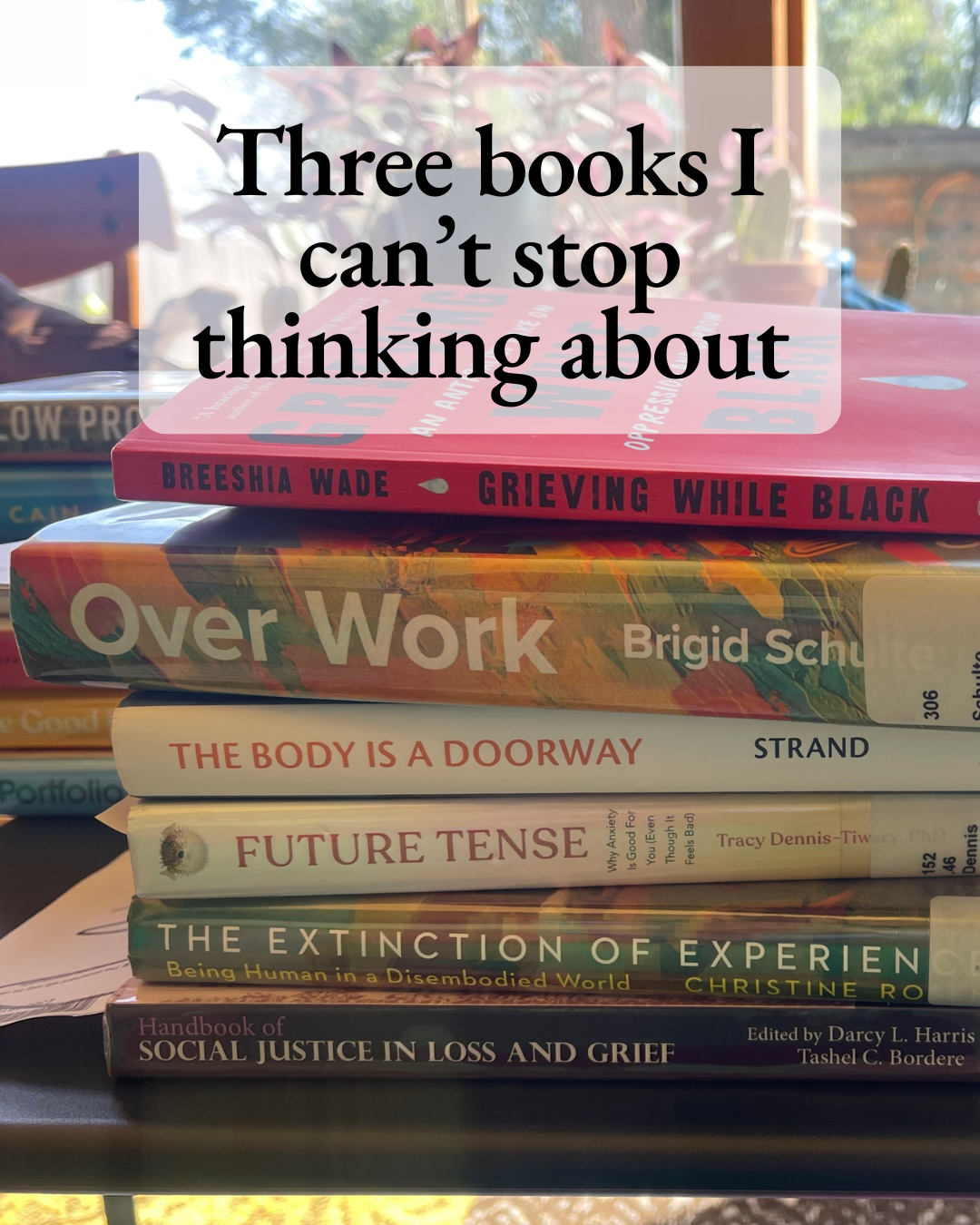
Three books I can’t stop thinking about
Being full-on in the brainstormy stage of a creative endeavor means I’m joyfully surrounded by piles and piles of library books. The middle pile is my active reading pile, aka the books I’m rotating through depending on the moment and my mood.
My summer reading and listening have me thinking deeply about overwork, career grief, embodiment, and the future of work.
The one skill I wish was in all workplaces
I keep thinking about how many workplaces, or even ourselves, are asking people to navigate precarity and uncertainty, maybe even calling for business-as-usual. Even if meant with good intentions, it doesn’t work. We’re calling it burnout or time to bounce back, but it's so much more than that at this point. And that rhetoric likely causes unintentional hurt because we live and work in a grief-averse society and have lost this critical skillset.
Working in the intersection of career and climate grief, there’s a lot of commonality and overlap with how folks are experiencing losses that are tangible and intangible, individual and collective.

What’s the university going to do?
In the last couple of months, I’ve worked with two different universities in different parts of the country, one on the West Coast and one in the Midwest, but all saying versions of the same thing.
Higher education, along with the country, is rapidly changing in directions we didn’t anticipate, and it is negatively impacting our sense of belonging and wellbeing. We need to figure out how we will cope so that we can then equip others through this.
Help your program or team stay resourced
We made it to midyear, it’s time to start planning for the second half, and I’m here to be your coconspirator in that. We’re all familiar with the traditional way that programs and organizations plan for what is ahead -- think the typical strategic or quarterly planning or start-of-the-academic-year retreat. Often including some teambuilding and then a long focus on goals, strategy, programming, and what needs to get done for the year ahead. These days, the messages come with mandates to innovate faster with fewer resources or get more students in seats and keep them there.
While there are parts in those messages and planning that still matter, they are by no means the top priorities for these upcoming months and years in these times of uncertainty and growing instability. I need you to know that grief is on the rise and it’s lurking under most conversations I have these days.

Widening the midline of your heart, body, and year
Midyear can be a chance to pause, reconnect with your heart, body, and boundaries, and notice how you want to tend your time and energy with more intention. Reflection, grief, and growth are often intertwined, asking us to stay open without overextending as we move into the second half of the year.
Small nudges as a way to move forward
When you are deep in career uncertainty, it is very easy to make the next step carry the weight of the whole future.
Updating your CV can feel like admitting you are leaving. Looking at job postings can feel like betrayal or panic, not to mention fear of what’s there (and a whole lot of what’s not there). Naming a boundary can feel like the beginning of an ending. Staying can feel like giving up, while leaving can feel like abandoning everything you worked so hard to build.
No wonder most new client conversations start with some version of feeling stuck and unclear.